Posts mit dem Label Oceans werden angezeigt. Alle Posts anzeigen

Samstag, 14. Februar 2026

Snowball Earth’s Liquid Seas Dipped Way Below Freezing - from EOS

 Snowball Earth’s Liquid Seas Dipped Way Below Freezing
Iron isotopes show that salty seawater pockets beneath the ice were as cold as −15°C.
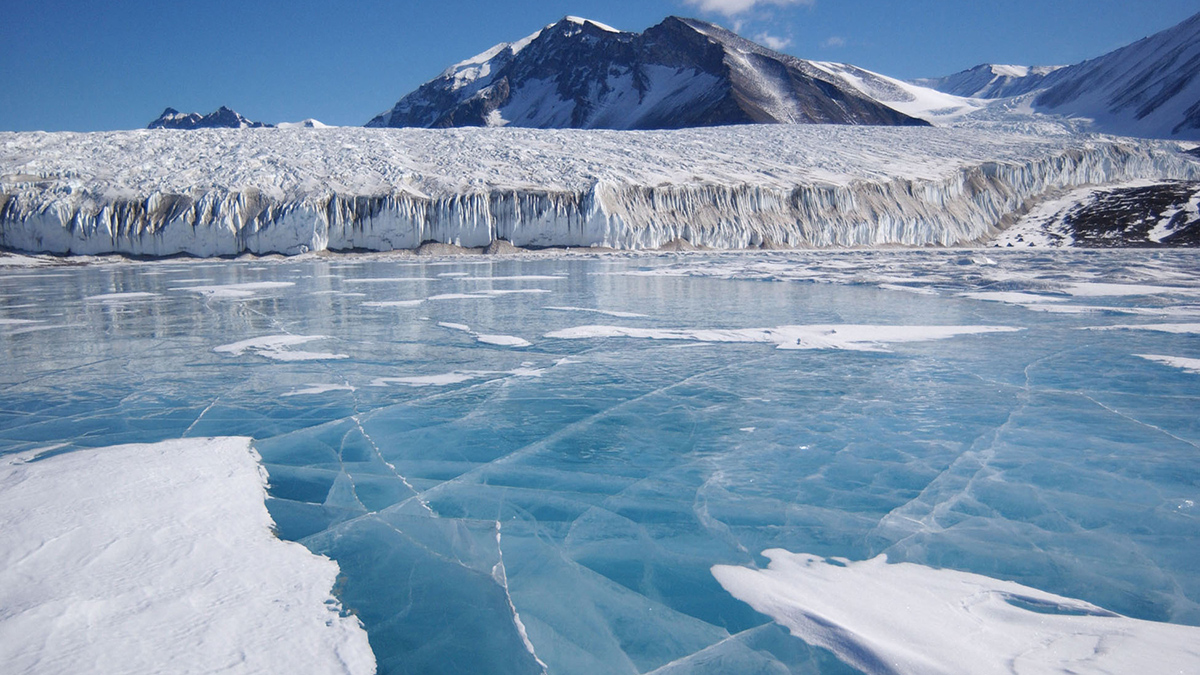
A frozen lake in Antarctica has a blue surface crisscrossed by lines. Behind it is a glacier, a mountain, and a blue sky.
In Antarctic lakes such as Lake Fryxell, fresh water freezes over briny liquid water. New research suggests that the liquid seawater during “snowball Earth” was up to 4 times saltier than modern ocean water, meaning it could reach much lower temperatures before freezing. Credit: Joe Mastroianni, National Science Foundation/Wikimedia Commons

Earth froze over 717 million years ago. Ice crept down from the poles to the equator, and the dark subglacial seas suffocated without sunlight to power photosynthesis. Earth became an unrecognizable, alien world—a “snowball Earth,” where even the water was colder than freezing.

In Nature Communications, researchers reported the first measured sea temperature from a snowball Earth episode: −15°C ± 7°C. If this figure holds up, it will be the coldest measured sea temperature in Earth’s history.

For water to be that cold without freezing, it would have to be very salty. And indeed, the team’s analysis suggests that some pockets of seawater during the Sturtian snowball glaciation, which lasted 57 million years, could have been up to 4 times saltier than modern ocean water.

“We’re dealing with salty brines,” said Ross Mitchell, a geologist at the Institute of Geology and Geophysics of the Chinese Academy of Sciences. “That’s exactly what you see in Antarctica today,” he added, except that snowball Earth’s brines were a bit colder than even the −13°C salty slush of Antarctica’s ice-covered Lake Vida today.

Past Iron

The Sturtian snowball was a runaway climate catastrophe that occurred because ice reflects more sunlight than land or water. Ice reflected sunlight, which cooled the planet, which made more ice, which reflected more sunlight and so on, until the whole world ended up buried under glaciers that could have been up to a kilometer thick.

This unusual time left behind unusual rocks: Rusty red iron formations that accumulated where continental glaciers met the ice-covered seas. To take snowball Earth’s temperature, the team devised a new way to use that iron as a thermometer.
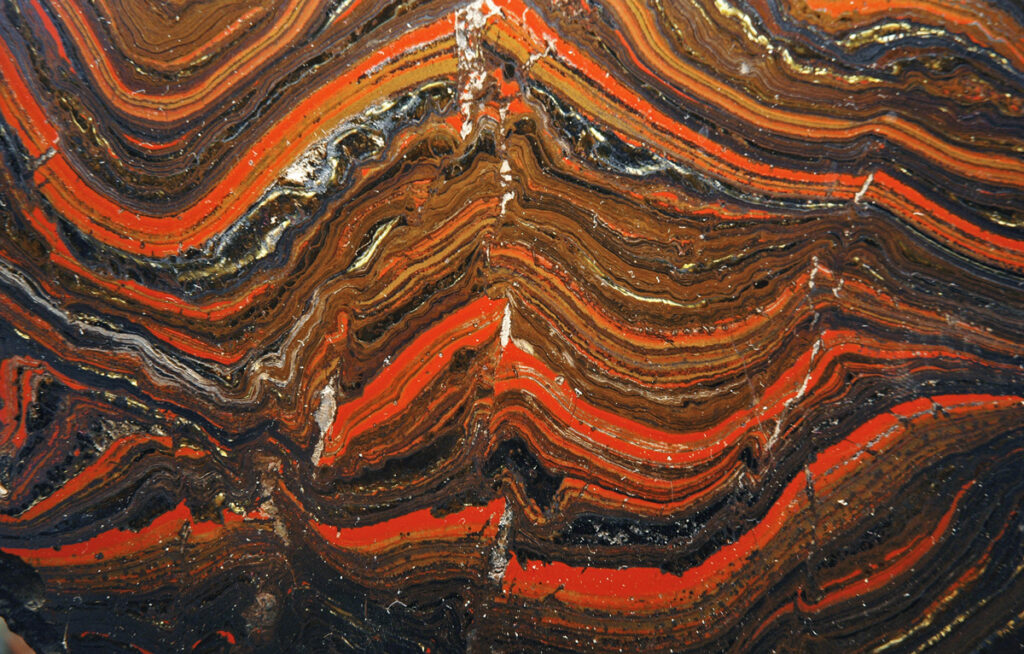
A cross section of a rock, made up of curved, alternating layers of browns and bright orange iron-rich oxides
Scientists used information about the iron in formations like this one to estimate the temperature of Earth’s ocean 717 million years ago. Credit: James St. John/Flickr, CC BY 2.0

Iron formations accumulate in water that’s rich in dissolved iron. Oxygen transforms the easily dissolved, greenish “ferric” form of iron into rusty red “ferrous” iron that stays solid. That’s why almost all iron formations are ancient, relics of a time before Earth’s atmosphere started filling with oxygen about 2.4 billion years ago, or from the more recent snowball Earth, when the seas were sealed under ice. Unable to soak up oxygen from the air or from photosynthesis, snowball Earth’s dark, ice-covered seawater drained of oxygen.

Iron-56 is the most common iron isotope, but lighter iron-54 rusts more easily. So when iron rusts in the ocean, the remaining dissolved iron is enriched in the heavier isotope. Over many cycles of limited, partial rusting—like what happened on the anoxic Archean Earth—this enrichment grows, which is why ancient iron formations contain isotopically very heavy iron compared to iron minerals that formed after Earth’s atmosphere and oceans filled with oxygen.

Snowball Earth’s iron is heavy, too, even more so than iron formations from the distant, preoxygen past. The researchers realized that temperature could be the explanation: Iron minerals that form in cold water end up istopically heavier. We don’t know exactly how hot it was when the ancient iron formations accumulated, but it was likely warmer than during snowball Earth, when glaciers reached the equator. Using a previous estimate of 25°C for the temperature of Archean seawater, the team calculated that the waters that formed the snowball Earth iron formations would likely have been 40°C colder.

“It’s a very interesting, novel way of getting something different out of iron isotope data,” said geochemist Andy Heard of the Woods Hole Oceanographic Institution, who was not involved in the study. “It’s a funny, backwards situation to be in where you’re using even older rocks as your baseline for understanding something that formed 700 million years ago.”

In part because of that backward situation, Heard thinks the study is best interpreted qualitatively as strong evidence that seawater was really cold, but maybe not that it was exactly −15°C.

The team also analyzed isotopes of strontium and barium to determine that snowball Earth’s seawater was up to 4 times saltier than the modern ocean. Jochen Brocks of the Australian National University, who wasn’t involved in the study, said the researchers’ results align with his own salinity analysis of snowball Earth sediments from Australia based on a different method. Those rocks formed in a brine that Brocks thinks was salty enough to reach −7°C before freezing. Another group reaching a similar conclusion using different methods makes that extreme scenario sound a lot more plausible, he said.

“It was very cool to get the additional confirmation it was actually very, very cold,” he said.

—Elise Cutts (@elisecutts.bsky.social), Science Writer

Citation: Cutts, E. (2026), Snowball Earth’s liquid seas dipped way below freezing, Eos, 107, https://doi.org/10.1029/2026EO260048. Published on 4 February 2026.
Text © 2026. The authors. CC BY-NC-ND 3.0
Except where otherwise noted, images are subject to copyright. Any reuse without express permission from the copyright owner is prohibited.
© 2026 American Geophysical Union. All rights reserved

Mittwoch, 11. Februar 2026

The AMOC of the Ice Age Was Warmer Than Once Thought


An analysis of sediment cores indicates that North Atlantic waters were relatively warm and continued to circulate even under major climate stress during the Last Glacial Maximum.
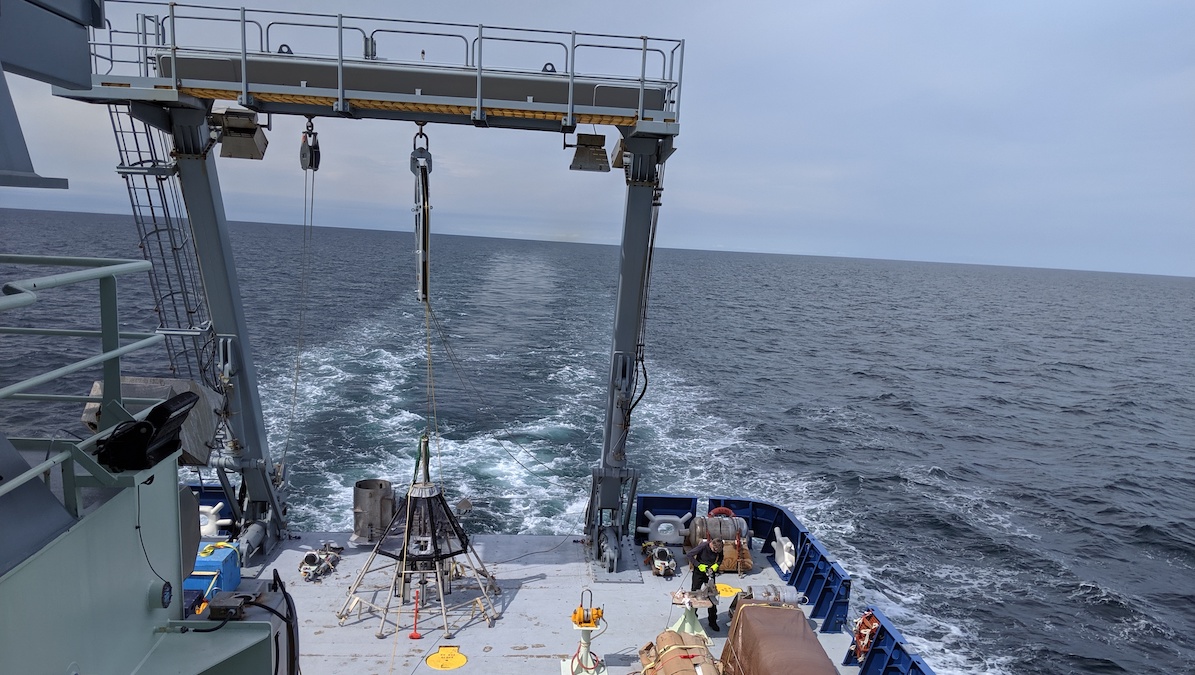
The back deck of a boat as it moves through the ocean.
Sediment cores collected by instruments such as this one on the back of R/V Neil Armstrong shed light on how the North Atlantic Ocean of the last ice age circulated. Credit: Alice Carter-Champion

A major part of the Atlantic Meridional Overturning Circulation (AMOC), a large-scale ocean circulation pattern, was warmer during the peak of Earth’s last ice age than previously thought, according to a new study published in Nature

The study’s results contrast with those from previous studies hinting that the North Atlantic was relatively cold and that AMOC was weaker when faced with major climate stress during the Last Glacial Maximum (LGM), about 19,000–23,000 years ago. 

The findings add confidence to models that scientists use to project how AMOC may change in the future as the climate warms, said Jack Wharton, a paleoceanographer at University College London and lead author of the new study.

Deepwater Data

The circulation of AMOC, now and in Earth’s past, requires the formation of dense, salty North Atlantic Deep Water (NADW), which brings oxygen to the deep ocean as it sinks and helps to regulate Earth’s climate. Scientists frequently use the climatic conditions of AMOC during the LGM as a test to determine how well climate models—like those used in major global climate assessments—simulate Earth systems. 

However, prior to the new study, few data points existed to validate scientists’ models showing the state of NADW during the LGM. Scientists in 2002 analyzed fluid in ocean bottom sediment cores from four sites in the North Atlantic, South Pacific, and Southern Oceans, with results suggesting that deep waters in all three were homogeneously cold.

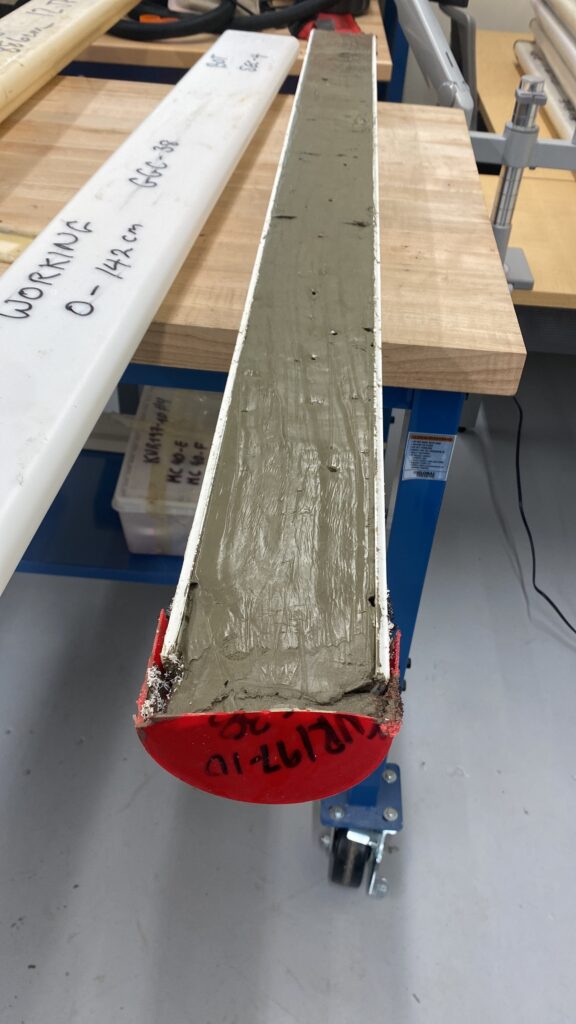
A tube of sediment about a yard long, sliced in half lengthwise so the muddy sediment is visible.
Researchers sampled 16 sediment cores from across the North Atlantic to deduce how waters may have circulated during the peak of the last ice age. Credit: Jack Wharton, UCL

“The deep-ocean temperature constraints during the [Last Glacial Maximum] were pretty few and far between,” Wharton said. And to him, the 2002 results were counterintuitive. It seemed more likely, he said, that the North Atlantic during the peak of the last ice age would have remained mobile and that winds and cold air would have cooled and evaporated surface waters, making them saltier, denser, and more prone to create NADW and spur circulation.

“This is quite new,” he remembered thinking. “What kind of good science could help show that this is believable?”

Wharton and his colleagues evaluated 16 sediment cores collected across the North Atlantic. First, they measured the ratio of trace magnesium and calcium in microscopic shells of microorganisms called benthic foraminifera. This ratio relates to the temperature at which the microorganisms lived. The results showed much warmer North Atlantic Deep Water than the 2002 study indicated. 

Wharton felt cautious, especially because magnesium to calcium ratios are sometimes affected by ocean chemistry as well as by temperature: “This is quite new,” he remembered thinking. “What kind of good science could help show that this is believable?”

The team, this time led by Emilia Kozikowska, a doctoral candidate at University College London, verified the initial results using a method called clumped isotope analysis, which measures how carbon isotopes in the cores are bonded together, a proxy for temperature. The team basically “did the whole study again, but using a different method,” Wharton said. The results aligned. 

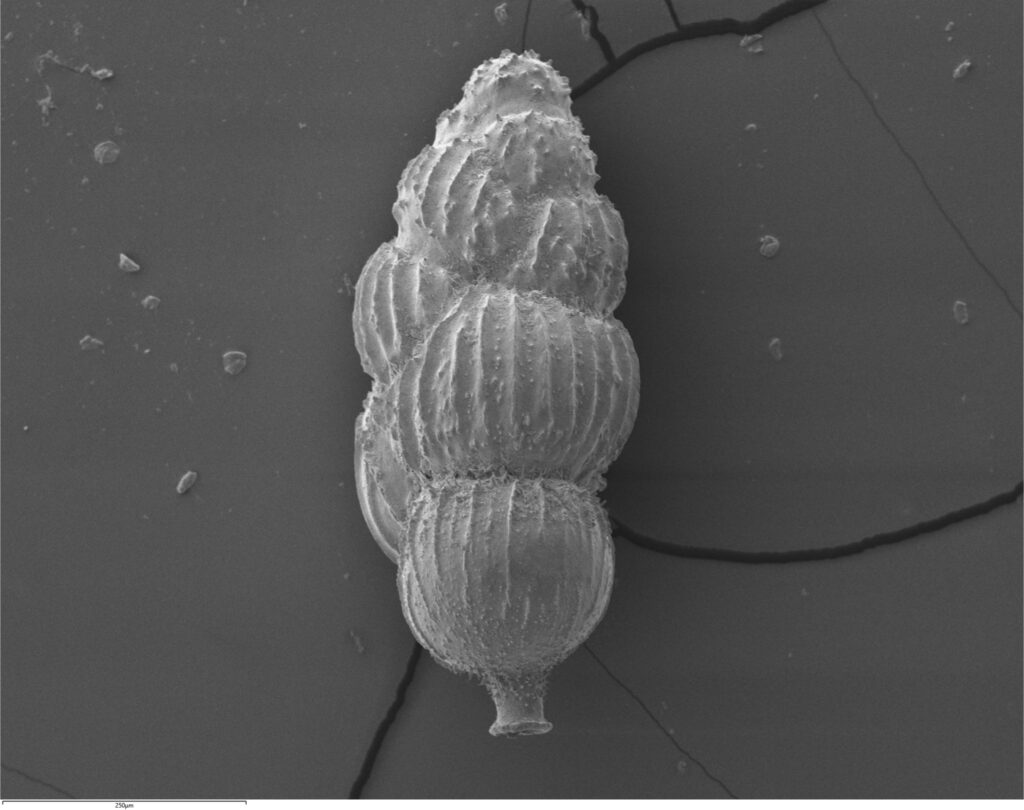
A grayscale microscopic image of the shell of a microorganism.
Ratios of magnesium to calcium contained in benthic foraminifera, tiny microbes living in marine sediment, offer insights into the temperature of North Atlantic waters thousands of years ago. Credit: Jack Wharton and Mark Stanley

Analyzing multiple temperature proxies in multiple cores from a broad array of locations made the research “a really thorough and well-done study,” said Jean Lynch-Stieglitz, a paleoceanographer at the Georgia Institute of Technology who was not part of the research team but has worked closely with one of its authors. 

The results, in conjunction with previous salinity data from the same cores, allowed the team to deduce how the North Atlantic likely moved during the LGM. “We were able to infer that the circulation was still active,” Wharton said. 

Modeling AMOC

The findings give scientists an additional benchmark with which to test the accuracy of climate models, Lynch-Stieglitz said. “LGM circulation is a good target, and the more that we can refine the benchmarks…that’s a really good thing,” she said. “This is another really nice dataset that can be used to better assess what the Last Glacial Maximum circulation was really doing.”

“Our data [are] helping show that maybe AMOC was sustained.”

In many widely used climate models, North Atlantic circulation during the LGM looks consistent with the view provided by Wharton’s team’s results, indicating that NADW was forming somehow during the LGM, Lynch-Stieglitz said. However, no model can completely explain all of the proxy data related to the LGM’s climatic conditions.

“Our data [are] helping show that maybe AMOC was sustained,” which helps reconcile climate models with proxy data, Wharton said. Lynch-Stieglitz added that a perhaps equally important contribution of the new study is that it removes the sometimes difficult-to-simulate benchmark of very cold NADW during the LGM that was suggested in research in the early 2000s. “We don’t have to make the whole ocean super cold [in models],” she said.

Some climate models suggest that modern-day climate change may slow AMOC, which could trigger a severe cooling of Europe, change global precipitation patterns, and lead to additional Earth system chaos. However, ocean circulation is highly complex, and models differ in their ability to project future changes. Still, “if they could do a great job with LGM AMOC, then we would have a lot more confidence in their ability to project a future AMOC,” Lynch-Stieglitz said.

Wharton said the results also suggest that another question scientists have been investigating about the last ice age—how and why it ended—may be worth revisiting. Many hypotheses rely on North Atlantic waters being very close to freezing during the LGM, he said. “By us suggesting that maybe they weren’t so close to freezing…that sort of necessitates that people might need to rethink the hypotheses.”

—Grace van Deelen (@gvd.bsky.social), Staff Writer

Citation: van Deelen, G. (2026), The AMOC of the ice age was warmer than once thought, Eos, 107, https://doi.org/10.1029/2026EO260053. Published on 10 February 2026.
Text © 2026. AGU. CC BY-NC-ND 3.0
Except where otherwise noted, images are subject to copyright. Any reuse without express permission from the copyright owner is prohibited.

Snowball Earth’s Liquid Seas Dipped Way Below Freezing - from EOS

  Snowball Earth’s Liquid Seas Dipped Way Below Freezing Iron isotopes show that salty seawater pockets beneath the ice were as ...